 WikiTrade
Schrödinger's cat
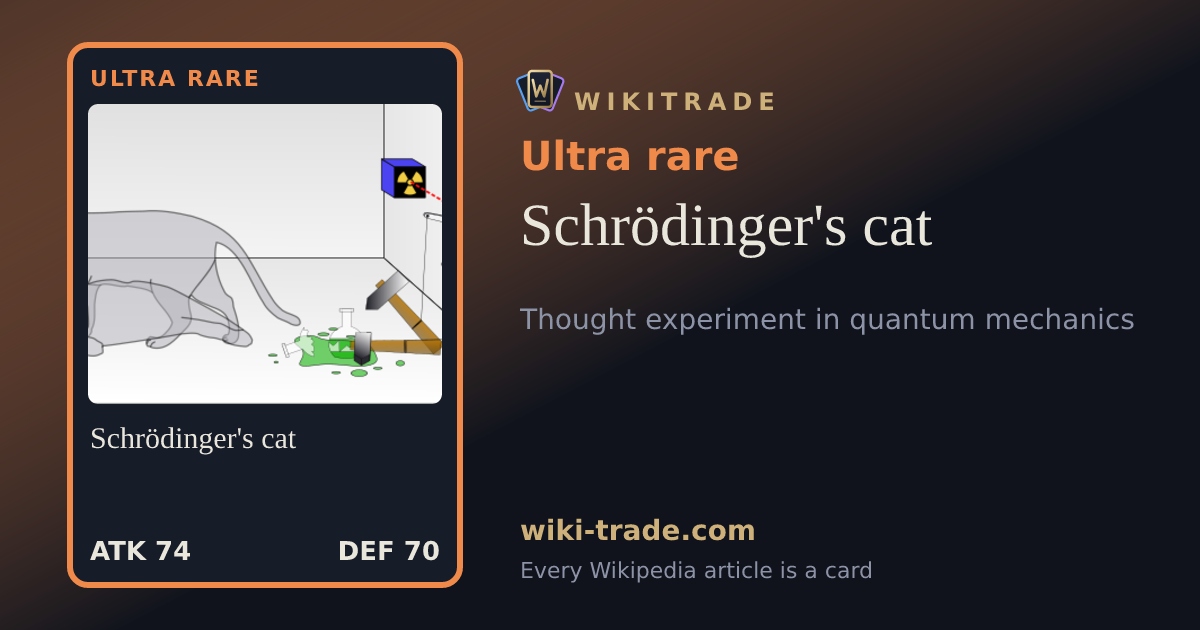
In quantum mechanics, Schrödinger's cat is a thought experiment concerning quantum superposition. In the thought experiment, a hypothetical cat inside a closed box may be considered to be simultaneously both alive and dead while it is unobserved, as a result of its fate being linked to a random subatomic event that may or may not occur. This experiment, viewed this way, is described as a paradox. This thought experiment was devised by physicist Erwin Schrödinger in 1935, in a discussion with Albert Einstein, to illustrate what Schrödinger saw as the problems of Niels Bohr and Werner Heisenberg's philosophical views on quantum mechanics.
On WikiTrade, every Wikipedia article is a card: the more the article is read, the rarer the card. Open free packs, complete your album, trade, bid and challenge others to general-knowledge duels.
Play for freeRead the article on WikipediaText from Wikipedia (CC BY-SA 4.0). WikiTrade is an independent site, not affiliated with Wikipedia or the Wikimedia Foundation.