 WikiTrade
Intercept theorem
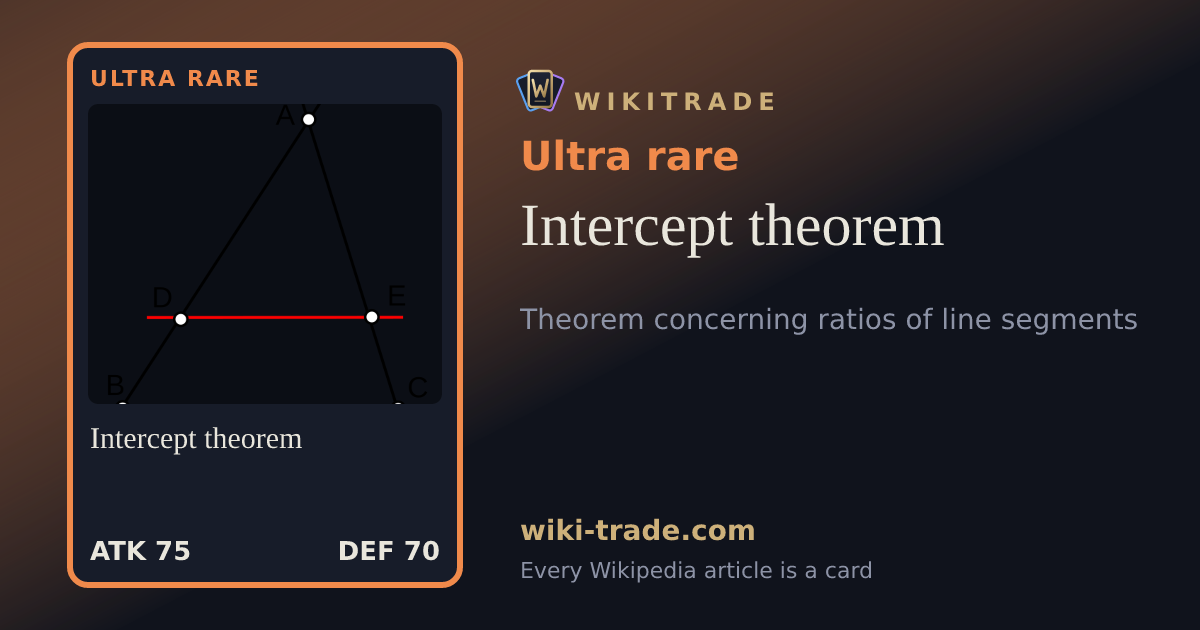
The intercept theorem, also known as Thales's theorem, basic proportionality theorem or side splitter theorem, is an important theorem in elementary geometry about the ratios of various line segments that are created if two rays with a common starting point are intercepted by a pair of parallels. It is equivalent to the theorem about ratios in similar triangles. It is traditionally attributed to Greek mathematician Thales. It was known to the ancient Babylonians and Egyptians, although its first known proof appears in Euclid's Elements. A mechanical device which produces geometrically-similar shapes is known as a pantograph.
On WikiTrade, every Wikipedia article is a card: the more the article is read, the rarer the card. Open free packs, complete your album, trade, bid and challenge others to general-knowledge duels.
Play for freeRead the article on WikipediaText from Wikipedia (CC BY-SA 4.0). WikiTrade is an independent site, not affiliated with Wikipedia or the Wikimedia Foundation.