 WikiTrade
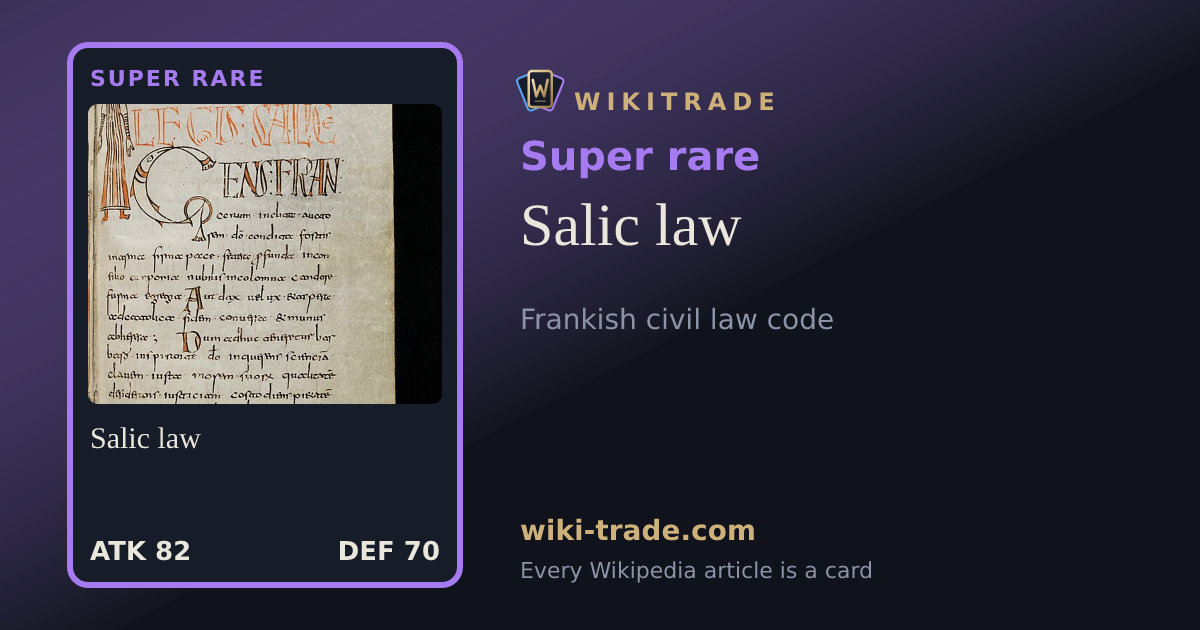
Salic law
The Salic law, also called the Salian law, was a Frankish civil law code compiled around 500 AD by Clovis, the first Frankish king. The name may refer to the Salii, or "Salian Franks", but this is debated. The written text is in Late Latin, and contains some of the earliest known instances of Old Dutch. It remained the basis of Frankish law throughout the early medieval period, and influenced future European legal systems. The best-known tenet of the old law is the principle of exclusion of women from inheritance of thrones, fiefs, and other property. The Salic laws were arbitrated by a committee appointed by the Frankish king. Dozens of manuscripts dating from the 6th to 8th centuries and three emendations as late as the 9th century have survived.
On WikiTrade, every Wikipedia article is a card: the more the article is read, the rarer the card. Open free packs, complete your album, trade, bid and challenge others to general-knowledge duels.
Play for freeRead the article on WikipediaText from Wikipedia (CC BY-SA 4.0). WikiTrade is an independent site, not affiliated with Wikipedia or the Wikimedia Foundation.