 WikiTrade
Rorschach test
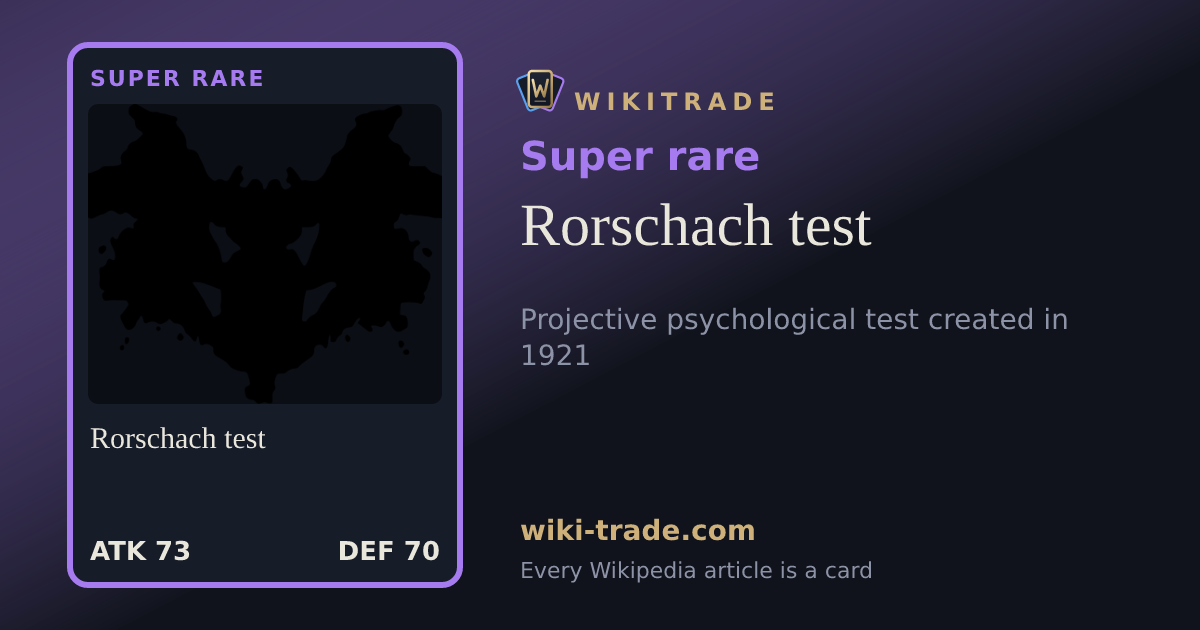
The Rorschach test is a projective psychological test in which subjects' perceptions of inkblots are recorded and then analyzed using psychological interpretation, complex algorithms, or both. Some psychologists use this test to examine a person's personality characteristics and emotional functioning. It has been employed to detect underlying thought disorder, especially in cases where patients are reluctant to describe their thinking processes openly. The test is named after its creator, Swiss psychologist Hermann Rorschach. The Rorschach can be thought of as a psychometric examination of pareidolia, the active pattern of perceiving objects, shapes, or scenery as meaningful things to the observer's experience, the most common being faces or other patterns of forms that are not present at the time of the observation. In the 1960s, the Rorschach was the most widely used projective test.
On WikiTrade, every Wikipedia article is a card: the more the article is read, the rarer the card. Open free packs, complete your album, trade, bid and challenge others to general-knowledge duels.
Play for freeRead the article on WikipediaText from Wikipedia (CC BY-SA 4.0). WikiTrade is an independent site, not affiliated with Wikipedia or the Wikimedia Foundation.