 WikiTrade
Dark matter
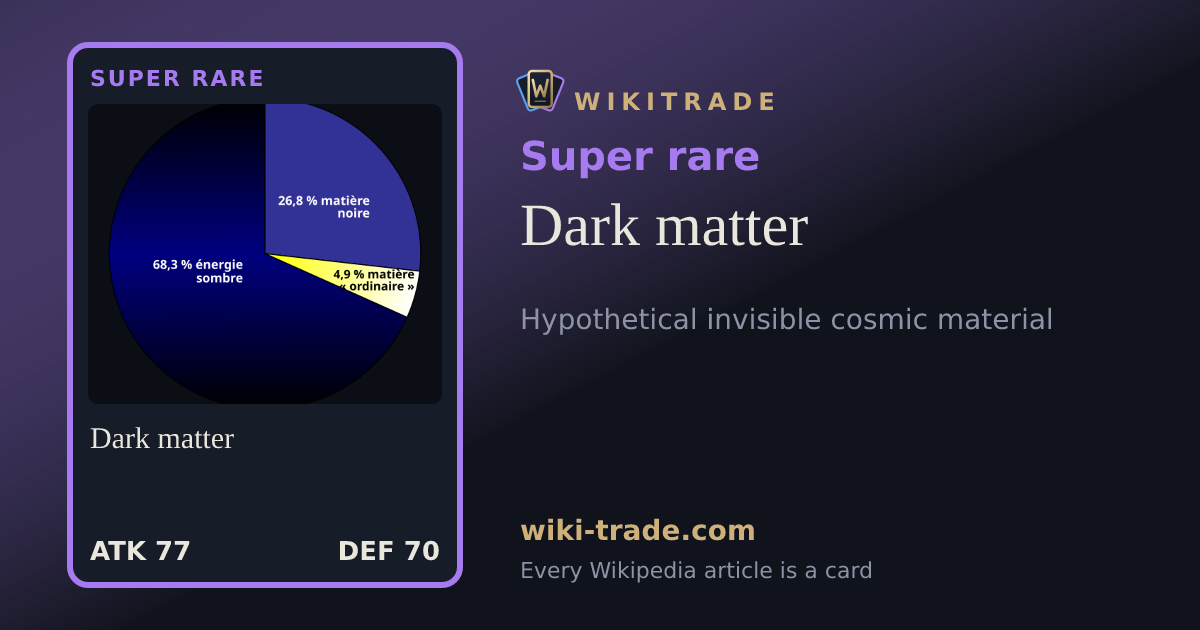
In astronomy and cosmology, dark matter is an invisible and hypothetical form of matter that does not interact with electromagnetic radiation, including light. Dark matter is implied by gravitational effects that cannot be explained by general relativity unless more matter is present than can be observed. Such effects occur in the context of formation and evolution of galaxies, gravitational lensing, the observable universe's current structure, mass position in galactic collisions, the motion of galaxies within galaxy clusters, and cosmic microwave background anisotropies. Dark matter is thought to serve as gravitational scaffolding for cosmic structures. After the Big Bang, dark matter clumped into blobs along narrow filaments with superclusters of galaxies forming a cosmic web at scales on which entire galaxies appear like tiny particles.
On WikiTrade, every Wikipedia article is a card: the more the article is read, the rarer the card. Open free packs, complete your album, trade, bid and challenge others to general-knowledge duels.
Play for freeRead the article on WikipediaText from Wikipedia (CC BY-SA 4.0). WikiTrade is an independent site, not affiliated with Wikipedia or the Wikimedia Foundation.