 WikiTrade
History of Belgium
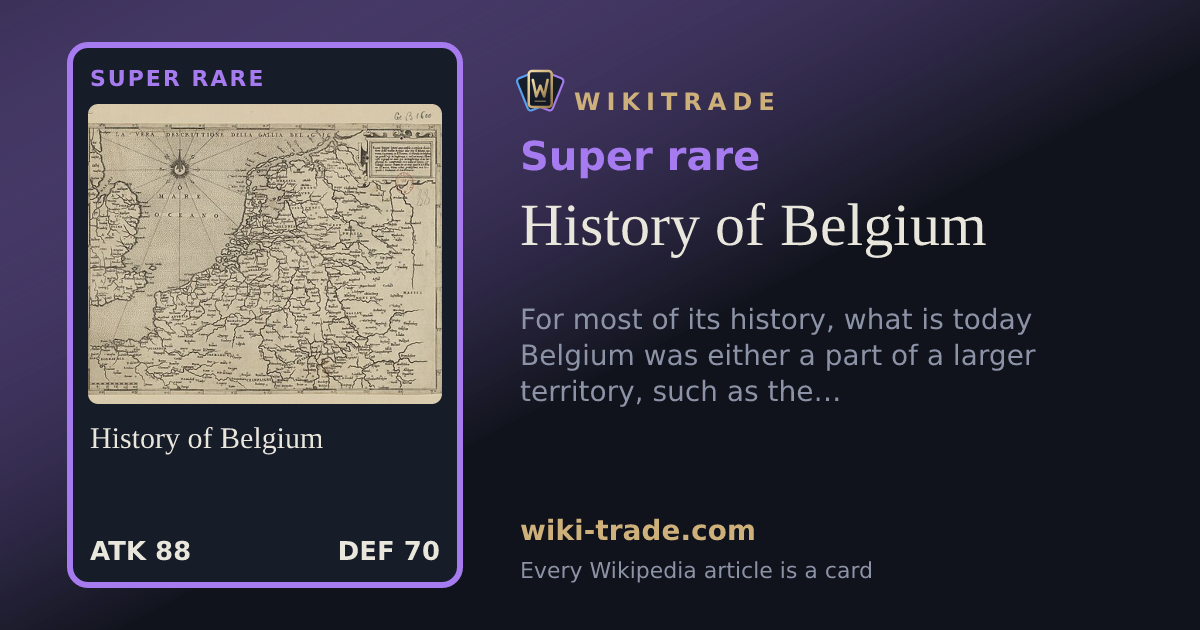
For most of its history, what is today Belgium was either a part of a larger territory, such as the medieval Carolingian Empire, or was divided into a number of smaller states. For much of the Middle Ages, the territory of present-day Belgium was fragmented into several feudal principalities, including the Duchy of Brabant, the County of Flanders, the Prince-Bishopric of Liège, the County of Namur, the County of Hainaut and the County of Luxembourg. Belgium's modern shape can be traced back at least as far as the Spanish Netherlands during the Eighty Years' War (1568–1648), which is when the Dutch Republic in the north split from the Southern Netherlands from which Belgium and Luxembourg developed. The area briefly came under Bourbon control during the War of the Spanish Succession. The resulting Peace of Utrecht transferred the area back to Habsburg control, creating the Austrian Netherlands. The French Revolutionary wars led to Belgium becoming part of France in 1795. After the defeat of the French in 1814, the Congress of Vienna created two new states, the United Kingdom of the Netherlands and the Grand Duchy of Luxembourg, which were placed in dynastic union under the House of Orange-Nassau. The Southern Netherlands rebelled during the 1830 Belgian Revolution, establishing the modern Belgian state, officially recognized at the London Conference of 1830. The first King of Belgium, Leopold I, assumed the throne in 1831.
On WikiTrade, every Wikipedia article is a card: the more the article is read, the rarer the card. Open free packs, complete your album, trade, bid and challenge others to general-knowledge duels.
Play for freeRead the article on WikipediaText from Wikipedia (CC BY-SA 4.0). WikiTrade is an independent site, not affiliated with Wikipedia or the Wikimedia Foundation.