 WikiTrade
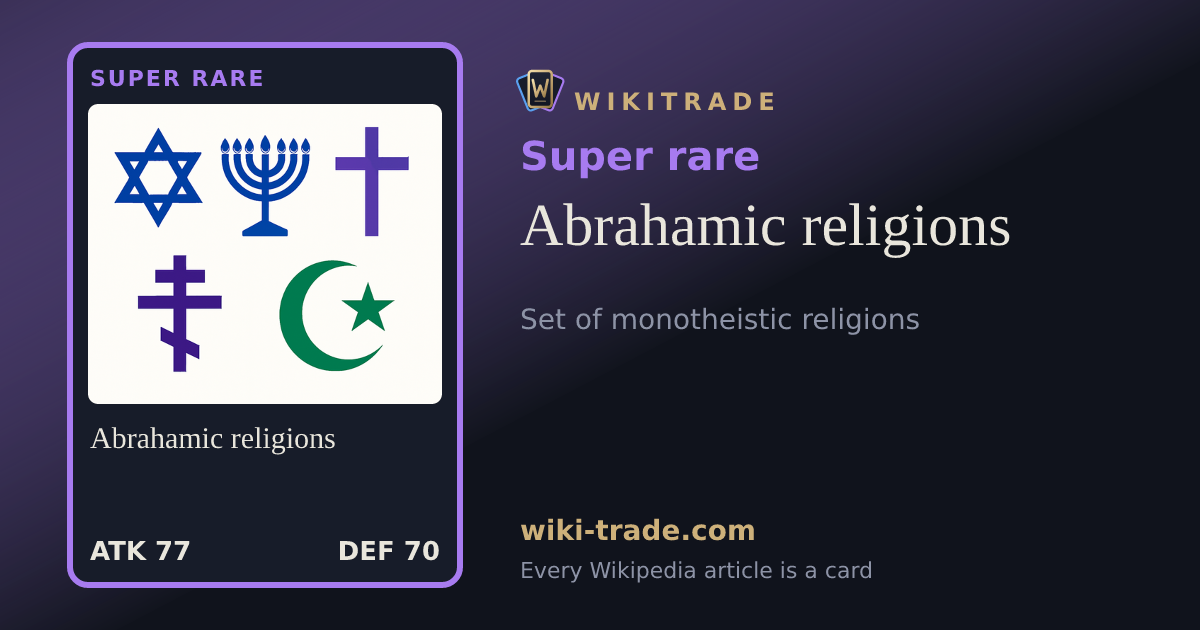
Abrahamic religions
The Abrahamic religions are a set of monotheistic religions that respect or admire the religious figure Abraham as a patriarch and/or as a prophet, namely Judaism, Christianity and Islam, as well as smaller religions such as the Baháʼí Faith, the Druze faith, Rastafari, and Samaritanism. The term may also include religions such as Yazidism, Mandaeism, Yarsanism, Shabakism, although their status as Abrahamic religions is highly controversial and hotly debated because their doctrines set them significantly apart from other Abrahamic religions. The religions of this set share doctrinal, historical, and geographic overlap that contrast them with Indian religions, Iranian religions, and East Asian religions, although some smaller Abrahamic religions, such as the Baha'i Faith, are also Iranian religions. Judaism, Christianity, and Islam, are the three largest Abrahamic religions, with Christianity and Islam being followed and adhered to by around half of the world's population. The term, introduced in the 20th century, replaced "Judeo-Christian" to include Islam as an Abrahamic religion and acknowledge differences between Judaism and Christianity, while the Baháʼí Faith, the Druze faith, Rastafari, and Samaritanism were recognized and classified as Abrahamic religions by a significant minority of scholars in the 20th century. However, the term has been criticized by some scholars for reportedly oversimplifying cultural and doctrinal nuances between the different religions.
On WikiTrade, every Wikipedia article is a card: the more the article is read, the rarer the card. Open free packs, complete your album, trade, bid and challenge others to general-knowledge duels.
Play for freeRead the article on WikipediaText from Wikipedia (CC BY-SA 4.0). WikiTrade is an independent site, not affiliated with Wikipedia or the Wikimedia Foundation.