 WikiTrade
Supermassive black hole
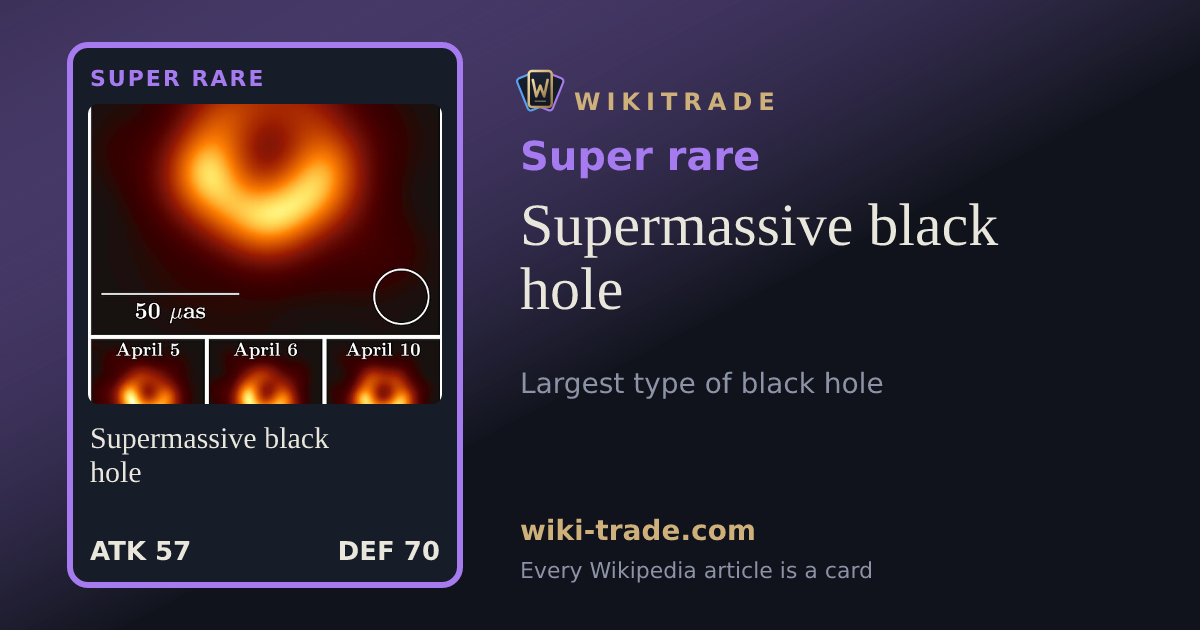
A supermassive black hole is the largest type of black hole, with its mass being on the order of hundreds of thousands, or millions to billions, of times the mass of the Sun (M☉). Black holes are a class of astronomical objects that have undergone gravitational collapse, leaving behind spheroidal regions of space that nothing, not even light, can escape. Observational evidence indicates that almost every large galaxy has a supermassive black hole at its center. For example, the Milky Way galaxy has a supermassive black hole at its center, corresponding to the radio source Sagittarius A*. Accretion of interstellar gas onto supermassive black holes is the process responsible for powering active galactic nuclei (AGNs) and quasars.
On WikiTrade, every Wikipedia article is a card: the more the article is read, the rarer the card. Open free packs, complete your album, trade, bid and challenge others to general-knowledge duels.
Play for freeRead the article on WikipediaText from Wikipedia (CC BY-SA 4.0). WikiTrade is an independent site, not affiliated with Wikipedia or the Wikimedia Foundation.